HeiChips26 Hackathon (RISCV-CPU)
Task specific RISC-V CPU to drive MMIO Accelerator
How Tiny Can a Task-Specific RISC-V Core Be?
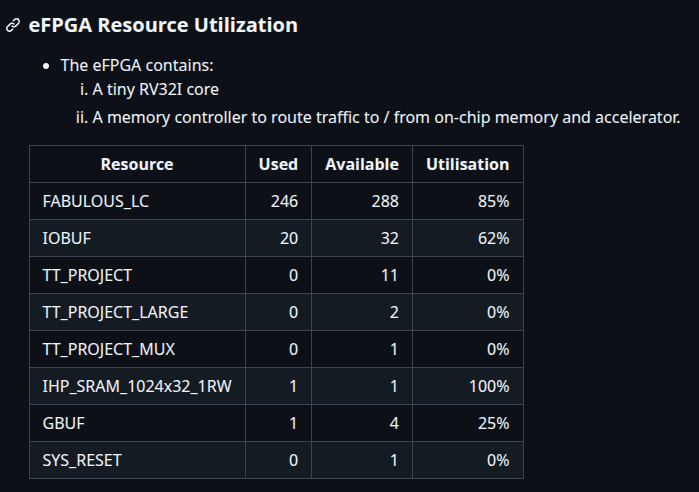
What about 246 LUT4s out of just 288 available? 🚀
My team Shangeeth, Udaya Subedi, Udara Mendis and I participated in the HeiChips26 Summer School & Hackathon, where we designed an ASIC-based DNA alignment MMIO accelerator using the Smith-Waterman algorithm. To control the accelerator, we also developed our own task-specific RISC-V CPU.
The challenge: the chip has a tiny eFPGA with only 288 LUT4s, so our CPU had to fit within this extremely tight resource budget.
We first evaluated two well-known open-source RISC-V cores:
- 🔹 PicoRV32: 2,247 LUT4s → 780% utilization
- 🔹 SERV: 2,770 LUT4s → 961% utilization
Both were far beyond our available resources.
So, we designed our own minimal RISC-V core specifically for our application.
After a lot of optimization and brainstorming, we achieved:
- ✅ 246 LUT4s → 85% utilization
- ✅ ~9× smaller than PicoRV32
- ✅ ~11× smaller than SERV
Key Design Decisions
-
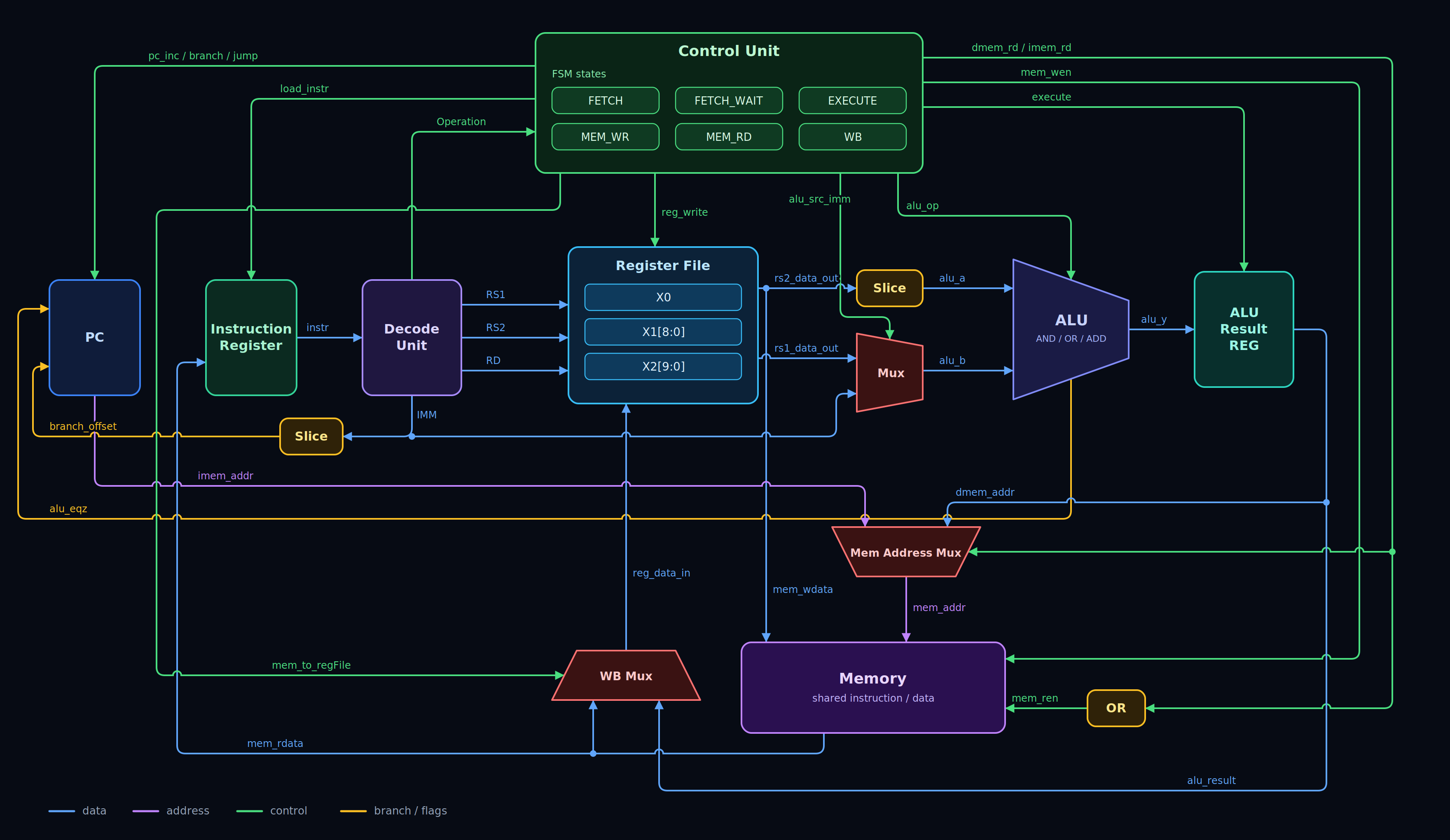
Register file with only 3 registers
- X0 – Hardwired to zero.
- X1 [8:0] – Holds data to/from the accelerator and memory.
- X2 [9:0] – Holds the address of the accelerator or memory location.
-
Simplified ALU with only 3 operations
- AND – Used to isolate status register bits.
- OR
- ADD – Used mainly for address calculations.
-
BEQZ – A simplified branch operation that branches when the ALU output is zero.
-
10-bit memory address width
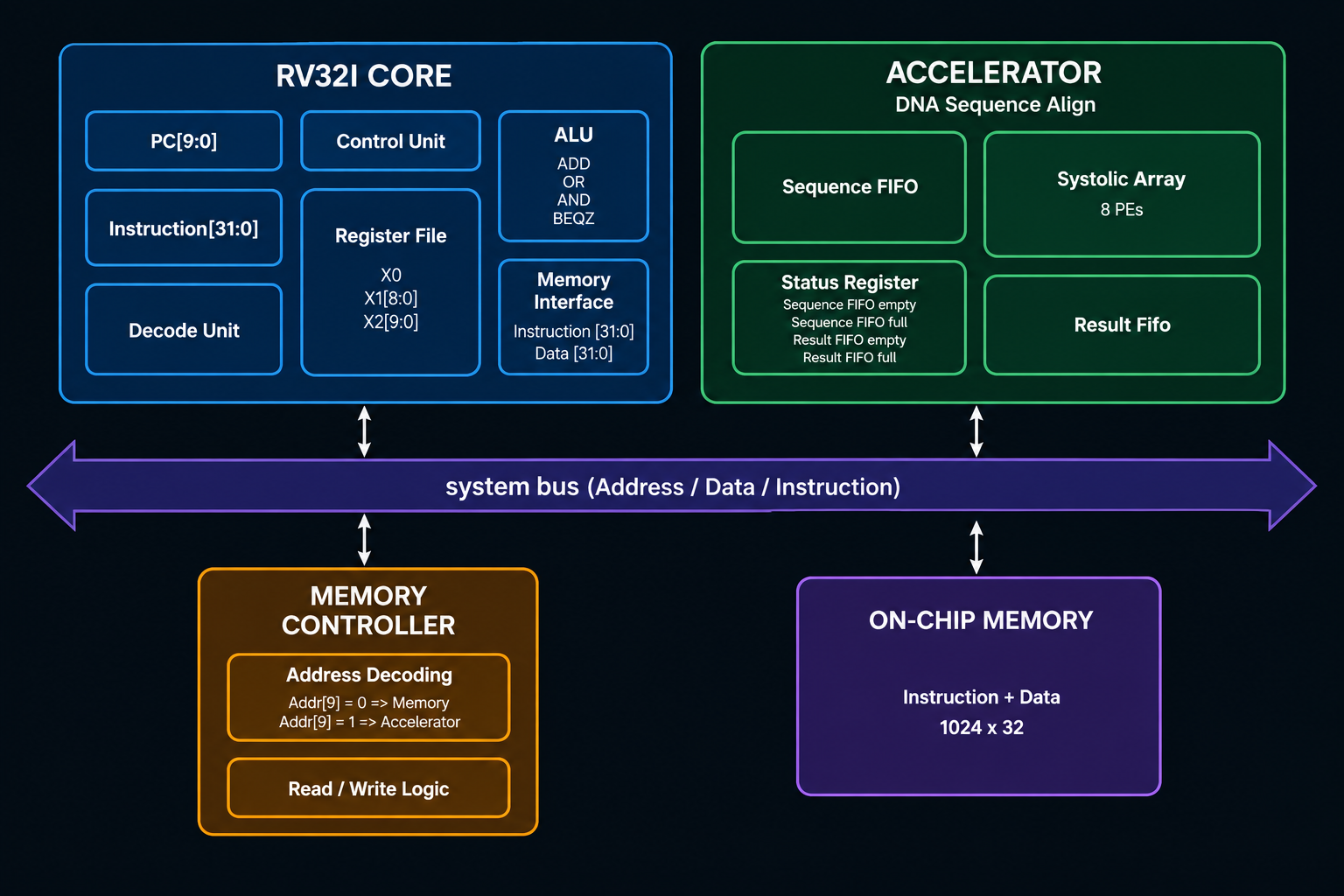
- The available on-chip SRAM is only 4 KiB (1024 × 32-bit), so there was no need for a larger address space.
-
Multi-cycle implementation with 6 states
- Fetch
- Fetch_wait
- Execute
- Mem_wr
- Mem_rd
- WB
-
Von Neumann architecture
- Instructions and data share the same memory.
We then benchmarked our core against PicoRV32. Interestingly, our much smaller CPU could drive the accelerator 1.99× faster for our workload.
This optimization comes with trade-offs. Because our processor has only two writable registers besides X0, it is not capable of handling conventional for loops or while loops efficiently. Therefore, the loops in our application had to be flattened into individual instructions. As a result, the assembly program takes considerably more memory space. For example, processing 20 DNA sequence pairs requires around 400 instruction and data memory words.
We also cannot use the standard RISC-V toolchain to directly compile C code into machine code for our processor because of its limited instruction set and register file. We therefore had to manually write the assembly program.
However, for our goal—driving the accelerator at its highest performance while fitting into 288 LUT4s—it was sufficient.
We thoroughly simulated the design and emulated the complete system on an Artix-7 FPGA to validate it before tapeout.
This project taught us an important lesson:
When resources are extremely constrained, sometimes the best solution is not to optimize an existing design, but to rethink the architecture from the ground up.
A huge thank you to Prof. Dirk Koch, Leo Moser, and the entire HeiChips26 team for organizing the Summer School and Hackathon and giving us the opportunity to work toward our own real ASIC!
Special thanks to MSc. Tobias Jauch and MSc. Lucas Deutschmann from RPTU Kaiserslautern-Landau for their valuable ideas, feedback, and guidance throughout the hackathon.
🔗 Complete design and implementation: https://github.com/tharinduSamare/heichips26-DNA_sequencer
Custom RISCV CPU Architecture
SOC Architecture
eFPGA Resource Utilization
/ Contact
Let's talk.
Have a project, an idea, or just want to get in touch? You can find me through any of the channels below.
Kaiserslautern, Germany